Metallic epoxy in Ottawa, poured, never repeated
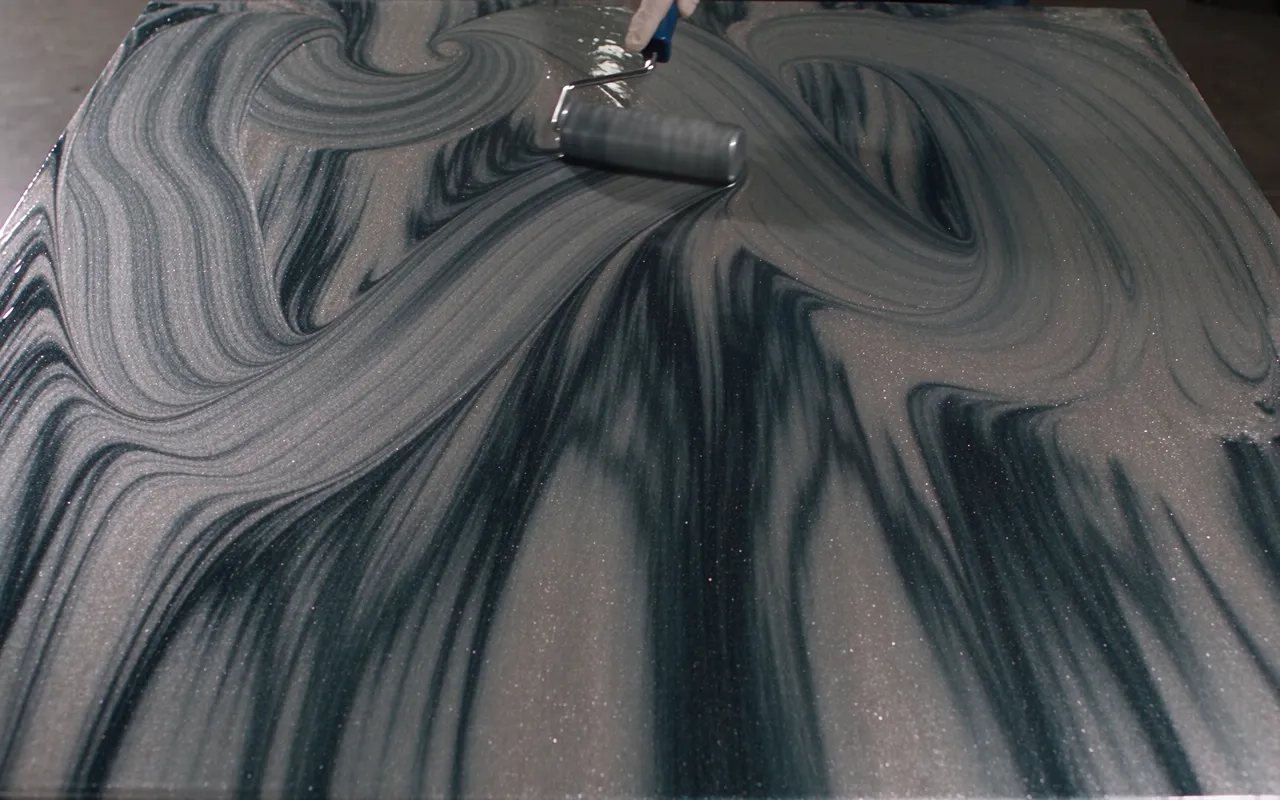
A metallic floor is the one people stop and stare at. Pearlescent pigment is floated through clear resin and moved by hand, so the floor sets into rivers, clouds and craters that look deep enough to put a hand into. No two are alike, and none can be made twice.
At a glance
- What it is
- Pearlescent pigment in clear, self-levelling resin
- Look
- Marbled, glossy, three-dimensional
- Best for
- Basements, showrooms, salons, studios
- Needs
- A flat, well-prepared slab
- Time on site
- Usually three to four days
How a metallic floor gets its depth
The effect looks like magic and is really physics. Metallic pigments are tiny reflective platelets, usually mica coated with metal oxides. Stirred into clear resin, they stay suspended and free to move while the resin is liquid. As the floor is poured and worked, the platelets tilt, drift and gather. Where they lie flat they flash like metal. Where they stand on edge the floor looks dark and deep.
When the resin gels, everything stops where it is. The pattern you see is a frozen record of how the liquid was moving in its last few minutes: every pass of the roller, every puff of air, every drop of solvent. That is why the floor looks three-dimensional even though it is perfectly flat and smooth to the touch.
It is also why no metallic floor can be copied. The installer controls the colours, the technique and the overall character. The fine detail is decided by the resin itself. Two floors poured from the same pails on the same day by the same person will be cousins, not twins.
If you want a floor to match a photograph exactly, this is the wrong finish. If you want one that could only exist in your room, it is the right one.
How a metallic floor is installed
Metallic work is slower and more exacting than any other resin floor, because the finish hides nothing.
Grind and flatten
The slab is diamond-ground, and every crack, pit, ridge and low spot is repaired. A metallic floor is glossy and self-levelling, so flaws in the concrete show through it like a pebble under a tablecloth.
Prime
A pigmented epoxy primer, usually black or dark grey, seals the concrete and gives the metallic its background. On a basement slab this is a moisture-tolerant primer.
Pour the metallic
Clear, high-solids epoxy mixed with the metallic pigments is poured in ribbons and spread with a notched squeegee to an even depth.
Work it
The wet floor is rolled, dragged, swirled or misted to move the pigment. This is the part done by eye and by experience.
Leave it alone
The floor levels and sets on its own. Dust, footprints and draughts are kept away from it until it has hardened.
Seal
One or two clear topcoats protect the metallic from scratches, traffic and sunlight.
Why the slab matters more for metallic epoxy than for anything else
Every resin floor depends on preparation, but metallic epoxy is the one that punishes shortcuts where you can see them. The metallic coat is poured as a liquid and finds its own level. It is also glossy enough to act as a mirror. Put those together and the finished floor becomes a very accurate map of whatever is underneath it.
A ridge left by a crack repair shows as a line in the reflection. A low spot collects extra resin and pigment and sets darker than the floor around it. A patch of concrete that was not ground properly absorbs the primer differently and can ghost through as a dull shape. None of this would be noticed under flake. All of it is visible under metallic.
So the first two days of a metallic job look much like a concrete finisher's work. Cracks and joints are filled and ground until a straightedge passes over them. Pitted areas are skimmed. On a rough or uneven slab, a self-levelling epoxy or cement underlayment may be poured first to give a true surface. Then the whole floor is primed and checked under a low raking light, which shows flaws the way the finished gloss will.
Moisture gets the same attention. Most metallic floors in Ottawa go into basements, and basement slabs sit on damp ground. Vapour moving up through the concrete is the main cause of blisters and cloudy patches in clear resin. The slab is tested, and where the readings call for it a moisture-tolerant epoxy primer is applied before any metallic is mixed.
Techniques, and the looks they make
The same colours can produce very different floors depending on how the resin is handled.
Which floor system suits your room?
Say what the room is and what matters to you. The answer names a system and the reasons, the same way it would be explained standing on your slab.
What is the room?
What matters to you? Pick all that apply.
Where metallic belongs, and where it does not
Metallic floors do their best work indoors, in rooms where people walk and the floor is meant to be looked at: finished basements, home theatres and bars, salons, boutiques, restaurants, studios and car showrooms.
They are less at home under a daily driver. A metallic floor is smooth, glossy and dark more often than not, which is the combination that shows fine scratches, tire marks and salt dust most clearly. It will not fail in a garage if it is installed properly and sealed with a hard topcoat, but it will ask to be cleaned far more often than a flake floor, and grit dragged in on winter tires will dull the shine in the wheel paths.
For a garage that is used as a garage, the honest advice is usually flake epoxy. For a collector garage, a showroom or a room where the car is the furniture, metallic is spectacular.
Where it suits
- Finished basements
- The classic use. Seamless, warm underfoot with radiant heat, nothing for moisture to rot.
- Showrooms and retail
- A floor that does the job of a display.
- Salons and studios
- Hair, colour and spills wipe off a sealed surface.
- Restaurants and bars
- Front of house. Kitchens want a textured floor.
- Working garages
- Possible, but flake is the more practical choice.
Smooth resin floors are slippery when wet. An anti-slip additive in the topcoat is recommended near entrances.
Choosing colours
Metallic pigments come in silvers, pewters, charcoals, coppers, bronzes, golds, blues, greens and pearls. Most floors use one main colour and one or two accents, and restraint usually looks more expensive than variety.
The primer colour underneath changes everything. Silver over black reads as dark, moody storm cloud. The same silver over a light grey primer is bright and airy. Copper over black looks like molten metal, and over brown like polished leather.
Think about the room as well as the floor. A basement with no windows can carry a dark, dramatic floor because the lighting is controlled. A shop with full-height glass will show every colour shift as the sun moves, which can be the best thing about it.
The floor designer on the main page gives a rough idea of four colourways. Treat it as a mood board. Real sample boards, made with the actual pigments, are what you choose from.
Metallic epoxy in Ottawa homes: where people put it
The rooms change from house to house, but the same handful come up again and again.
Metallic compared with the alternatives
If you are drawn to metallic for the look, these are the finishes it is usually weighed against.
| Metallic epoxy | Polished concrete | Tile or vinyl plank | |
|---|---|---|---|
| Look | Marbled, glossy, any colour | Natural grey stone, matte to gloss | Printed or fired pattern, repeating |
| Seams | None | None | Many: grout lines or joints |
| On a damp slab | Yes, over a moisture-tolerant primer | Yes | Risky under vinyl; grout can stain |
| Hides slab flaws | No, needs a flat floor | No, shows the slab as it is | Yes |
| Feel underfoot | Smooth and hard | Smooth and hard | Varies |
| Uniqueness | Every floor is different | Depends on the concrete | Repeats |
General comparison. The right choice depends on the room and the slab.
Living with a metallic floor
Day to day, a metallic floor is easy. There are no joints or grout lines, nothing soaks in, and a dust mop followed by a damp microfibre mop with a little pH-neutral cleaner is all it wants.
What it asks in return is a bit of care about grit. Sand and small stones under shoes are what take the shine off any glossy floor, so a good mat at the door does more for a metallic floor than any polish. Put felt pads under furniture, and lift heavy things when you move them.
Over the years the clear topcoat will pick up fine scratches in the busiest paths. This is normal, and it is the topcoat doing its job. The floor can be lightly abraded and given a fresh clear coat, which brings back the gloss without touching the metallic layer underneath.
Ask about a satin topcoat if you would rather not see every footprint. It softens the reflections and makes the floor far more forgiving, and the depth of the metallic still comes through.
What to expect from the job
A metallic epoxy floor is the slowest of the resin floors to install, and it is worth knowing why before you book. The room has to be completely empty, including anything that would normally be worked around. The heating and ventilation are set and then left alone, because a draught across wet resin moves the pigment and carries dust. Nobody, including the installer, walks on the floor between the pour and the next morning.
Plan for the room to be out of use for about a week from the first day of grinding to the day furniture goes back. Most of that is waiting. The work itself is a day or two of preparation, a day for the primer, a day for the metallic and a day for the clear coat.
You will be asked to approve a sample board before the pour. It shows the colours and the technique, made with the same materials. It cannot show the pattern, because that will only exist once, on your floor.
A typical schedule
- Days 1 and 2
- Grind, repair, flatten and vacuum.
- Day 3
- Prime. Check the surface under raking light.
- Day 4
- Pour and work the metallic coat.
- Day 5
- Clear topcoat, with anti-slip if chosen.
- After
- Light foot traffic in a day or two; furniture after about a week.
Typical timing. Large or uneven floors take longer.
Questions people ask
What is a metallic epoxy floor?
It is a clear, self-levelling epoxy carrying pearlescent metallic pigments. The pigment is moved while the resin is wet and sets into a marbled, three-dimensional pattern, which is then sealed under a clear topcoat.
Can I get the same floor I saw in a photo?
You can get the same colours and the same style, but not the same pattern. The fine detail forms as the resin flows and sets, so every metallic floor is unique.
Is metallic epoxy good for a garage?
It can be installed in a garage, but it is smooth and glossy and shows scratches, tire marks and salt dust more than a flake floor does. For a garage in daily use, flake is usually the more practical choice.
Is a metallic floor slippery?
When wet, yes, like any smooth glossy floor. A fine anti-slip additive can be mixed into the topcoat, with a small loss of gloss.
How long does a metallic floor take to install?
Usually three to four days, because the slab must be flattened and primed first, the metallic coat must set undisturbed, and the clear topcoat follows.
Can metallic epoxy go in a basement?
Yes, and it is one of its best uses. The slab is tested for moisture and primed with a moisture-tolerant epoxy where needed before the metallic is poured.
Will a metallic floor scratch?
The clear topcoat can pick up fine scratches over time, mostly from grit under shoes. Door mats and felt pads help, and the topcoat can be renewed later.
Does it yellow in sunlight?
Ordinary epoxy can amber in direct sun. A UV-stable clear topcoat is used to protect the floor where daylight reaches it.
How do I clean a metallic floor?
Dust-mop to remove grit, then damp-mop with warm water and a small amount of pH-neutral cleaner. Avoid abrasive pads and acidic or soap-based cleaners.
More from Epoxy Floors Ottawa
For the full picture, from surface preparation to cure times, and to watch a floor get coated as you scroll, see the main page for epoxy flooring in Ottawa, or go straight to a service.
Tell us about the room
613-851-7831Call for the quickest answer, or send the form. You will get a call back with the options for your slab and a price.