Epoxy Floors Ottawa
Epoxy flooringin Ottawa, from tiredconcrete to showroom
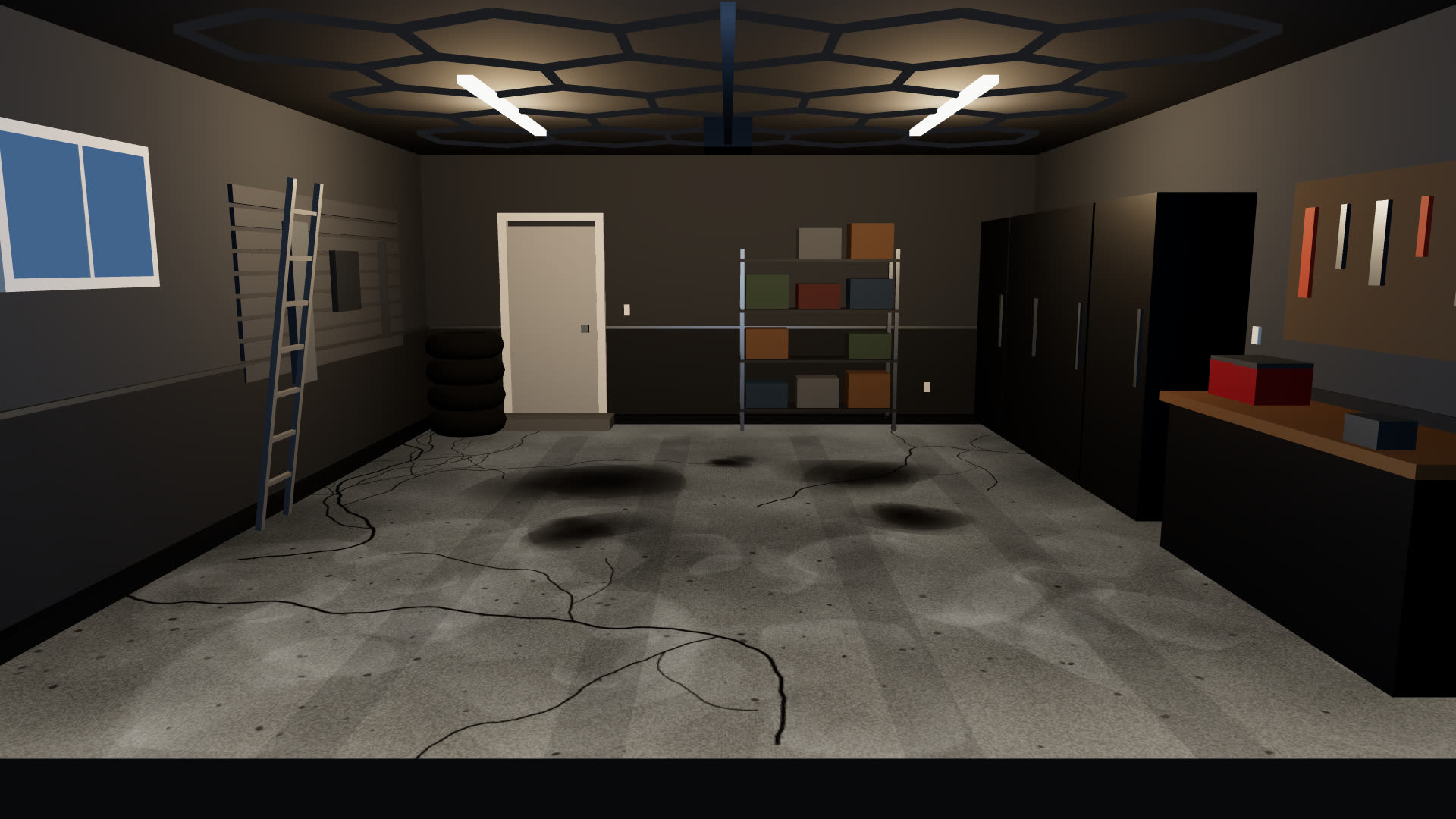
This is a real job, start to finish. Scroll and the floor in this garage is ground, coated, flaked and sealed in front of you. Then the car rolls in and you pick the finish.
- Garages, basements and shops
- Diamond-ground, never acid-washed
- Price before work starts
-
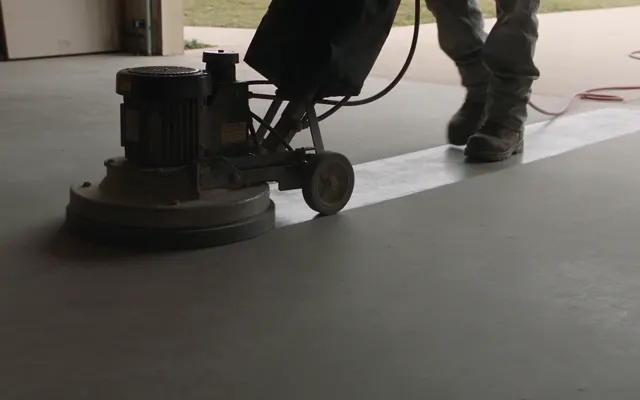 01Diamond grind
Open the concrete
The top of the slab, with its oil, salt and old sealer, is ground off with diamonds and vacuumed as it goes. A coating only holds as well as this step is done.
Why grinding beats acid -
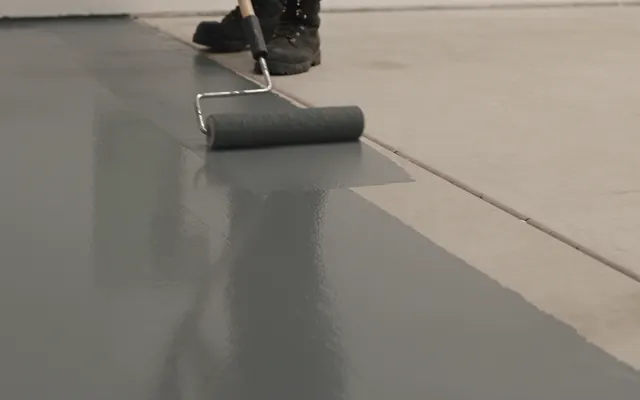 02Repair and base coat
Fill, then roll it wet
Cracks and salt pits are filled and ground flush. Then the pigmented base coat goes down thick and wet, soaking into the open concrete.
Epoxy garage floors in Ottawa -
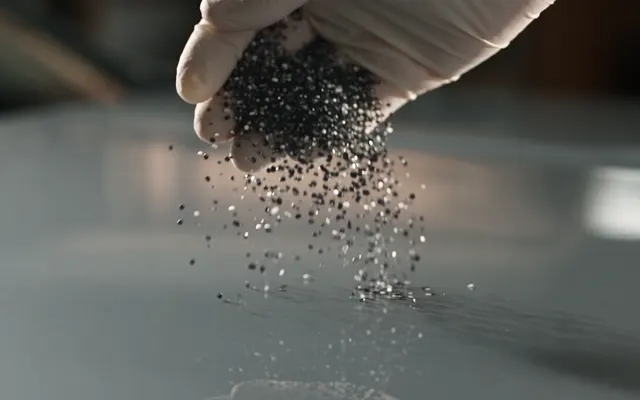 03Flake broadcast
Thrown until it refuses more
Vinyl flakes are thrown up and allowed to rain into the wet coat until the floor cannot take another chip. That is called broadcasting to rejection.
Flake epoxy in Ottawa -
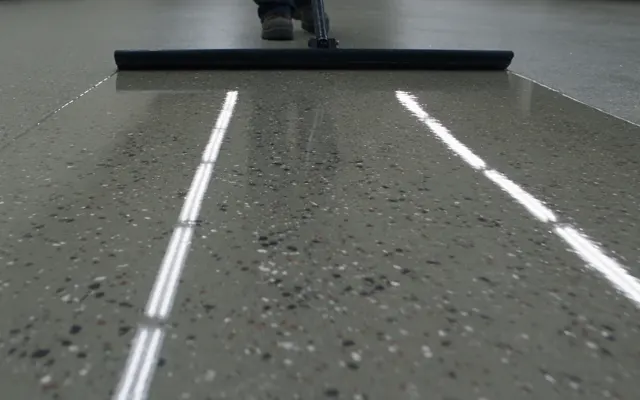 04Clear topcoat
Sealed under clear
Loose flake is scraped and vacuumed, then a clear, UV-stable topcoat locks everything in. This is the layer your tires, salt and jack stands actually touch.
What each layer does
Epoxy flooring in Ottawa: what you are really buying
Epoxy flooring in Ottawa is sold as a colour and a shine, but what you are paying for is mostly invisible. It is the hours spent grinding the slab before any resin is opened, the moisture check that decides which primer goes down, the cracks chased and filled, and the choice of topcoat that has to live with road salt, studded winter boots and a hot set of tires in July.
A resin floor is a system, not a paint. Two liquids are mixed, they react, and they cure into a hard plastic that is bonded into the top of the concrete. Done properly, an epoxy floor in an Ottawa garage shrugs off salt brine, oil, gas and dropped tools, wipes clean with a mop, and makes the room brighter because it throws light back at the ceiling. Done badly, it peels in sheets under the tires in its first winter.
The difference between those two floors is rarely the product. It is the preparation and the patience. That is why this page spends as much time on grinding, moisture and cure times as it does on colours, and why you get a written scope and a price before any work is booked.
Epoxy floors in Ottawa at a glance
- Garages
- Full-flake floors built for salt, slush and hot tires. Epoxy garage floors.
- The speckled look
- Colour blends, flake sizes and how much coverage to ask for. Flake epoxy.
- The marbled look
- Pearlescent floors for basements, showrooms and shops. Metallic epoxy.
- Shops and warehouses
- Kitchens, clinics, showrooms, bays and plant floors. Commercial epoxy.
- Prep
- Diamond grinding to a measured profile. No acid etching. Why it matters.
An epoxy floor in Ottawa has to survive five months of salt
Most advice about resin floors is written for places where a garage floor never sees worse than dust. Here, a car comes home carrying a few litres of salty meltwater in its wheel wells, drops it on the slab, and the furnace-warmed garage does the rest. Bare concrete soaks that brine up, and every freeze and thaw pries the surface a little further apart.
Epoxy Floors Ottawa coats garages, basements, workshops, showrooms and commercial floors across the city. You see real samples on your own slab before you choose, you are told plainly what your concrete needs first, and you get a price before any work is booked.
Why concrete in Ottawa needs more than a sealer
Concrete looks solid, but it is full of fine pores, a little like a very hard sponge. What gets into those pores decides how long the surface lasts. In this city, three things get in.
- 51,530tonnes of road salt the City of Ottawa spread between December 1, 2024 and January 6, 2025 alone, according to City figures reported by CTV News. A share of it rides home in your wheel wells.
- 33%more winter freeze-thaw events are projected for Ottawa by the 2050s in the City's climate projections. Each one is a chance for water in the slab to freeze, swell and lift the surface.
- CSP 2–3the surface profile, on the International Concrete Repair Institute's scale of 1 to 10, that diamond grinding leaves and that most resin floor coatings are designed to grip. More on that below.
Design your floor
Choose a finish and a colour and the floor below is redrawn. It is the quickest way to find out whether you are a flake person, a metallic person or a plain grey person.
Finish
Colour
Flake coverage
An illustration drawn in your browser, not a colour match. Real samples are laid on your own slab, in your own light, before you choose.
See it in your own garage
Add a photo of your floor, drag the four corners onto the concrete and choose a finish. The new floor is laid over your picture, keeping its light and shadows. The photo stays on your phone or computer. It is not uploaded anywhere.
Finish
Colour
This is a sample garage. Add your own photo, then drag the four round handles to the corners of the bare concrete.
- Stand at the door and take the photo in daylight
- An empty floor works best
- Drag a handle past the edge if a corner is out of the picture
A quick preview drawn in your browser, not a promise of the exact colour. Things standing on the floor are painted over, so mark only the bare concrete.
Resin floor systems, and what each one is for
"Epoxy" has become the everyday word for any poured resin floor, but several different chemistries and finishes hide behind it. These are the ones worth knowing before you ask for a price.
| System | What it is | Good at | Watch for |
|---|---|---|---|
| Solid-colour epoxy | A pigmented, high-solids epoxy in one colour, usually with a clear or tinted topcoat. | Workshops, storage rooms, plant floors, line marking. Clean and simple. | Shows dust, scratches and tire marks more than a patterned floor. |
| Flake (chip) floor | Vinyl flakes broadcast into a wet base coat, sealed under clear. | Garages. Hides dirt, adds grip, and the texture forgives an imperfect slab. | Ask whether it is a full broadcast or a light sprinkle. They wear very differently. |
| Metallic epoxy | Pearlescent pigments moved through clear epoxy to make a marbled, three-dimensional look. | Basements, showrooms, salons, retail. A one-off floor every time. | Smooth and glossy, so it shows scratches. Not the first choice under a daily driver. |
| Quartz broadcast | Coloured quartz sand broadcast into resin, sealed under clear. | Commercial kitchens, washrooms, locker rooms. Tough and grippy when wet. | Rougher to mop. Texture is chosen to suit the room. |
| Polyaspartic | A fast-curing, UV-stable resin, used as a topcoat or as the whole system. | Clear coats that do not yellow in sunlight, quick return to service, colder-weather installs. | Short working time. It rewards an experienced crew and punishes a slow one. |
| Urethane topcoat | A thin, hard-wearing clear or coloured finish over epoxy. | Abrasion and chemical resistance on commercial and industrial floors. | Thin by design, so it relies on the epoxy underneath for build. |
| Moisture-tolerant primer | An epoxy primer made to bond to damp concrete and hold back vapour. | Basements and slabs that fail a moisture test. | An extra step and an extra day, and worth both. |
| One-part "epoxy paint" | Acrylic or latex paint with a little epoxy resin in it, sold in hardware stores. | A quick cosmetic freshen-up on a floor that sees no cars. | It is paint. Under hot tires and salt it peels, and it has to be ground off before a real system goes down. |
General characteristics of each system. Exact performance depends on the product, the film thickness and the slab, and is listed on each product's technical data sheet.
Which floor system suits your room?
Say what the room is and what matters to you. The answer names a system and the reasons, the same way it would be explained standing on your slab.
What is the room?
What matters to you? Pick all that apply.
Preparation is the job
If one thing separates an epoxy floor that lasts from one that lifts, it is what happens before the first pail is mixed. Resin does not stick to concrete the way glue sticks to paper. It soaks into an open, roughened surface and locks around it as it cures. A slab that is smooth, sealed, oily or dusty gives it nothing to hold.
So the first day of a proper job is loud and unglamorous. A planetary grinder fitted with industrial diamonds takes off the top layer of the concrete: the weak, trowelled-smooth skin called laitance, any old sealer or paint, and the oil and salt held in the first fraction of a millimetre. A vacuum on the grinder's shroud collects the dust as it is made. Edges and corners are done by hand.
What is left is clean, open concrete with a texture like fine sandpaper. The trade measures that texture on the International Concrete Repair Institute's scale of concrete surface profiles, from CSP 1, nearly flat, to CSP 10, very rough. Thin coatings want about CSP 2 to 3, and grinding is how you get it.
Acid etching, the method on the back of the hardware-store kit, is not the same thing. Acid cannot remove sealers, oil or paint, it leaves the profile uneven, and it adds water and salts to a slab you then have to dry and neutralize. It is the single most common reason do-it-yourself garage floors fail.
Then come the repairs. Cracks are opened with a diamond blade so the filler has something to key into, filled with a fast-setting repair resin, and ground flush. Pitted, salt-eaten areas are rebuilt the same way. Only then is the floor ready for a coating.
What proper prep includes
- Diamond grinding
- The whole floor, wall to wall, to an open and even profile. Not a light sanding and not an acid wash.
- Dust control
- Grinders connected to industrial vacuums, so the dust goes into a drum and not onto your shelves.
- Moisture check
- The slab is tested before a primer is chosen. Damp slabs get a moisture-tolerant primer first.
- Crack and pit repair
- Cracks chased, filled and ground flush. Spalled areas rebuilt.
- Honest limits
- Control joints and moving cracks can show through again over time, and you are told that before you choose.
Surface profiles follow ICRI Guideline No. 310.2R, the reference most coating makers use in their data sheets.
Is your concrete ready for a coating?
Four questions about the slab. The answer tells you what has to happen before any resin goes down, and why.
How old is the concrete?
What is on it now?
What shape is it in?
Any sign of moisture?
A guide to what to expect, not an inspection. The slab is checked in person before a system is recommended.
Epoxy floor work across Ottawa
The four main services have their own pages. This is everything that goes with them, grouped the way people usually ask.
Epoxy, cold weather and when to book
Resin floors cure by chemical reaction, and like most reactions it slows down in the cold. Standard epoxies want the slab itself, not just the air, at around 10°C or warmer, and they cure best nearer room temperature. Below that they stay soft for days, and a coating that cures too slowly never reaches full hardness.
That is why most epoxy floors in Ottawa go down between late spring and mid-autumn, and why the calendar fills up fast in September, when everyone remembers that winter is coming. A heated, attached garage widens the window considerably. So do polyaspartic systems, which are made to cure quickly and at lower temperatures than epoxy.
Whatever the product, a new floor needs time before it meets a car. Light foot traffic comes first, usually within a day. Vehicles come last, and the first week matters most: this is when a floor is most easily marked by hot tires. The countdown beside this gives typical waiting times for the system and the temperature you choose. The data sheet for the product on your floor always has the final word.
- Before the job: empty the floor completely. Shelving on the walls can usually stay.
- During the cure: keep the door closed against dust, leaves and rain, and keep the heat steady.
- First winter: rinse or squeegee salty meltwater out now and then, and avoid dragging steel across the floor.
Cure countdown
When can I park on it?
Enter the day the topcoat went on, the system and how warm the slab is.
The system
The slab
- Walk on it in socks
- -
- Move things back
- -
- Park the car
- -
Typical times, not a guarantee. The data sheet for the product on your floor comes first.
How much floor do you have?
A price starts with the area. Pick a typical garage or enter your own measurements, and send the numbers with your request.
Start from
Typical inside dimensions. Measure wall to wall at the floor, and mention steps, posts and drains.
How it goes
You call or ask for a price
Tell us what the room is, roughly how big, and what shape the concrete is in. A few photos help, especially of cracks, pitting and any old paint. You get the options and a price before anything is booked.
The slab is looked at properly
Samples are laid on your own floor, in your own light. The concrete is checked for moisture, old sealers, cracks and salt damage, because those decide the primer and the repairs.
Grind, repair, coat, seal
The floor is diamond-ground and vacuumed, repaired, base-coated, broadcast with flake or finished in your chosen system, and sealed under a clear topcoat. Most garages take one to three days on site, depending on the system and the repairs.
Cure, then move back in
You are given clear times for walking, moving things back and parking, and a short care sheet for the first winter.
Living with an epoxy floor
The appeal of a resin floor is how little it asks of you. A few habits keep it looking the way it did on day one.
Epoxy floors for every part of Ottawa
Epoxy Floors Ottawa works across the city, inside and outside the Greenbelt. The slab under a 1960s bungalow and the slab under a three-year-old townhouse are not the same job, and they are not treated as one.
Kanata and Stittsville
Newer double garages with smooth, power-trowelled slabs, often sealed by the builder. They need a thorough grind before anything will bond.
Barrhaven and Riverside South
Young slabs in good shape, and busy family garages where the door to the house opens straight onto the floor. Grip matters here.
Orleans
Garages from the 1980s and 1990s that have seen thirty-odd winters of salt. Expect pitting where the tires sit, and plan for repairs.
Nepean and Alta Vista
Older bungalows and split-levels, single garages and carports turned into garages, with slabs that have cracked, settled and been patched.
Westboro, the Glebe and Old Ottawa South
Infill homes with tight, heated garages, and century-old basements where moisture is the first question, not colour.
Downtown and the ByWard Market
Restaurants, cafes, salons and shops that need a floor installed around opening hours.
Gloucester and the east-end business parks
Workshops, auto bays, warehouses and light industrial units along Sheffield, Lancaster and Canotek.
Manotick, Greely and the rural south
Big detached garages, workshops and barndominium-style buildings with a lot of floor and room to do it right.
Questions people ask
How long does an epoxy floor last?
It depends on the system, the preparation and the traffic. A professionally installed, high-solids floor on properly ground concrete lasts for many years in a home garage, and its clear topcoat can be renewed when it eventually wears. Thin one-part floor paints often fail within a year or two under cars.
How long does it take to install?
Most garages take one to three days on site. Fast-curing polyaspartic systems are the quickest. Metallic floors and large commercial floors take longer. You are given the schedule with the price.
When can I walk and park on it?
With a standard epoxy system at room temperature, you can usually walk on it after about a day and park on it after about five to seven days. Polyaspartic systems are faster. The cure countdown gives typical dates.
Can epoxy be installed in the winter in Ottawa?
In a heated space, yes. Standard epoxy needs the slab at about 10 degrees or warmer, so unheated garages are usually done between late spring and mid-autumn. Polyaspartic systems tolerate cooler slabs.
Is epoxy flooring slippery?
A smooth, glossy resin floor is slippery when wet. Flake and quartz floors have built-in texture, and a fine anti-slip additive can be added to any topcoat. Say so if the floor is an entrance or gets wet.
Do you acid etch the concrete?
No. The slab is diamond-ground, which removes sealers, oil and weak concrete and leaves an even profile for the resin to grip. Acid etching does none of those reliably. See why preparation is the job.
What is the difference between epoxy and polyaspartic?
Both are two-part resins. Epoxy builds thickness well and has a long working time, but cures slowly and ambers in sunlight unless it is top-coated. Polyaspartic cures in hours, is UV-stable and tolerates cooler temperatures, but has to be applied quickly. Many floors use both.
Will my cracks come back?
Cracks are opened, filled and ground flush before coating, and under a flake floor most disappear. A crack that is still moving, or a control joint, can show through again over time. You will be told which ones are likely to.
Can you coat a floor that was painted or coated before?
Yes. The old paint or coating is ground off to clean concrete first. A new system should never be applied over a failing one.
Can epoxy go on a basement floor?
Yes. The slab is tested for moisture first, and a moisture-tolerant epoxy primer is used where it is needed. A coating is not a fix for water that is coming into the basement.
How do I get a price?
Call 613-851-7831 or send the form below with the size of the floor and a few photos of the concrete. The floor area tool works out the square footage for you.
Tell us about your floor
613-851-7831Call for the quickest answer. Or send the form with the size of the floor, what shape the concrete is in and the finish you like, and you will get a call back with the options and a price.