Commercial epoxy in Ottawa, installed around your hours
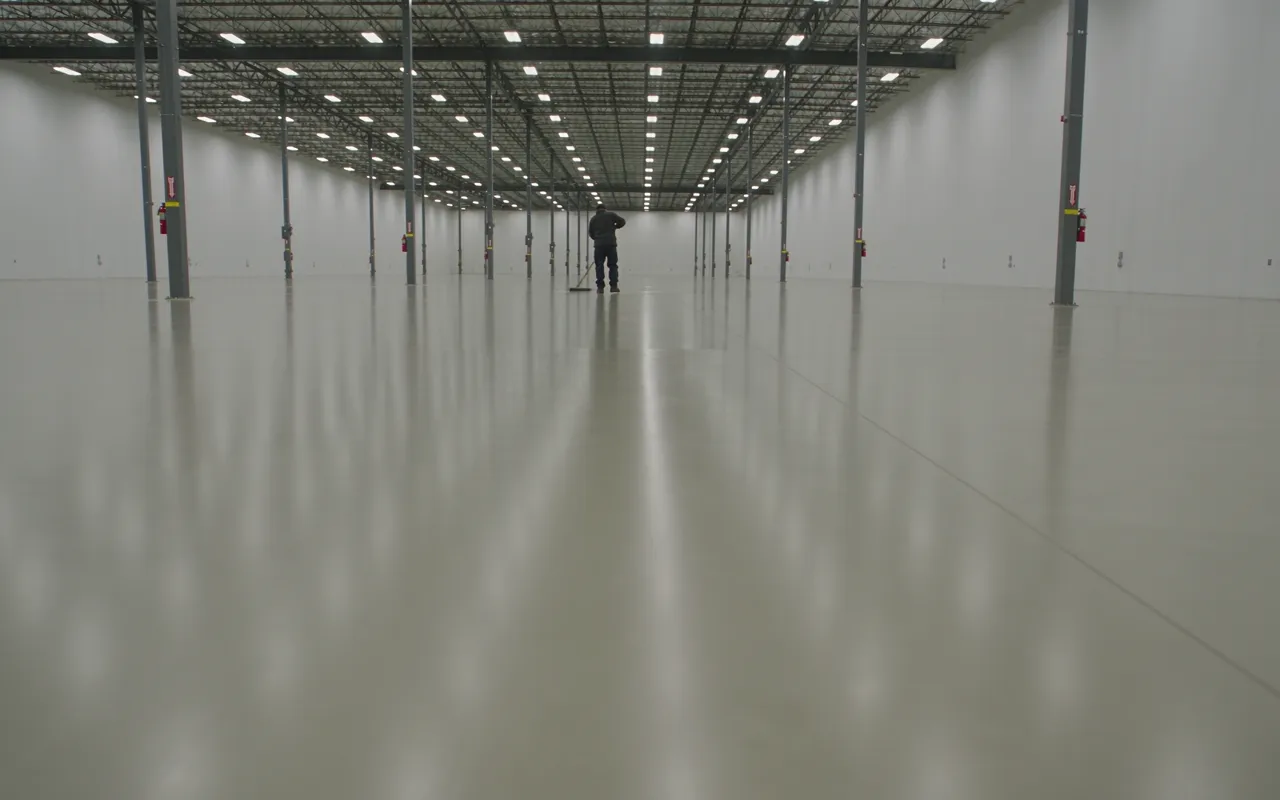
A commercial floor is a piece of equipment. It has to carry the traffic, stand up to whatever gets spilled on it, clean quickly and keep people on their feet. Resin flooring is chosen for businesses because it can be specified to do exactly that, room by room.
At a glance
- For
- Kitchens, clinics, retail, bays, warehouses, plants
- Scheduling
- Nights, weekends and phased areas
- Systems
- Epoxy, urethane, quartz, polyaspartic
- Extras
- Line marking, cove base, anti-slip
- Starts with
- A site visit and a written scope
Why businesses choose resin floors
Most commercial buildings in Ottawa sit on a concrete slab. Left bare, that slab dusts, stains and slowly wears. Covered with tile, it gains thousands of grout lines to scrub and edges to chip. Covered with sheet vinyl, it gains seams that lift and trap water.
A resin floor is poured in place and bonds to the concrete, so it has no seams, no grout and nothing to lift. It can be made as smooth as glass for a showroom or as grippy as sandpaper for a wash bay. It can be built thin where the traffic is light and thick where forklifts turn. And it can be made to resist whatever your business puts on a floor: fryer oil, brake fluid, hair colour, disinfectant or road salt.
That flexibility is why the same family of products ends up in restaurant kitchens, dental clinics, breweries, car dealerships, aircraft hangars and food plants. What changes from one to the next is the specification, and getting that right is the real work.
It also means there is no single price or product for commercial flooring. A site visit comes first, then a written scope that says what will be done, with what, and in which order.
By type of business
The questions are the same everywhere: what rolls on it, what spills on it, how is it cleaned, and how long can it be closed. The answers are not.
The main commercial systems
These are the systems most often specified. Many floors combine two of them in different areas.
| System | Build | Strengths | Typical use |
|---|---|---|---|
| High-build epoxy | Two coats of pigmented epoxy on a ground slab | Smooth, bright, economical, easy to line-mark | Warehouses, storage, light manufacturing |
| Epoxy with urethane topcoat | Epoxy for build, urethane for wear | Abrasion, chemical and UV resistance | Auto bays, hangars, showrooms |
| Quartz broadcast | Coloured quartz in resin, sealed | Grip when wet, heavy cleaning, decorative | Kitchens, washrooms, locker rooms |
| Flake broadcast | Vinyl flake in resin, sealed | Hides dirt, textured, attractive | Corridors, retail, customer areas |
| Urethane cement | A thick resin-and-cement mortar | Thermal shock, moisture, impact | Commercial kitchens, food and beverage |
| Polyaspartic | Fast-curing resin coats | Overnight return to service, UV-stable | Retail, restaurants, tight schedules |
| ESD and conductive | Epoxy with conductive elements | Controls static discharge | Electronics, labs, server rooms |
Typical systems. The specification for your floor follows the site visit and the product data sheets.
Which floor system suits your room?
Say what the room is and what matters to you. The answer names a system and the reasons, the same way it would be explained standing on your slab.
What is the room?
What matters to you? Pick all that apply.
Working around your business
For most businesses the hardest part of a new floor is not the cost. It is the closure. A floor that is being ground, coated and cured cannot be walked on, and every closed day has a price.
So the schedule is planned first. Fast-curing systems can be installed after closing and walked on the next morning. Larger floors are done in phases, one bay, one aisle or one room at a time, so the rest of the operation keeps running. Retail and restaurant work is often done overnight or across a weekend.
Dust is controlled at the source, with grinders and shot blasters connected to industrial vacuums. Low-odour, low-VOC products are used where a building is occupied or food is nearby. And the plan accounts for the things that are easy to forget: moving stock and equipment, protecting finished walls, access for the crew at night and ventilation while the floor cures.
What the scope covers
- Site visit
- Slab condition, moisture, joints, existing coatings, drains and traffic.
- Specification
- The system for each area, with thicknesses and finishes.
- Schedule
- Phasing, working hours and return-to-service times.
- Preparation
- Grinding or shot blasting, repairs and joint treatment.
- Details
- Cove base, line marking, anti-slip texture and transitions.
A written scope and price are provided before any work is booked.
What Ottawa conditions do to a commercial floor
Commercial epoxy in this city has a few extra jobs that the brochures, mostly written further south, do not mention. The first is the entrance. From November to April every customer and every delivery brings in salt, sand and meltwater. The first ten metres inside a door take more abuse than the rest of the floor put together. That zone should be specified on its own, with more texture, a tougher topcoat and a plan for matting.
The second is loading docks and overhead doors. A slab that is at room temperature for most of its length drops well below freezing within a few metres of an open dock door in January. Resin and concrete expand and contract at different rates, so joints near doors have to be detailed to move, and the coating has to be one that tolerates the cycling.
The third is timing. A heated building can be coated in any month, which is one reason a lot of commercial work in Ottawa is done in winter, when the residential season is quiet. An unheated warehouse or parking level cannot, unless the system is chosen for low temperatures and the slab is dry.
The fourth is parking structures and service garages, where chloride from road salt is not only a surface problem. It attacks the reinforcing steel inside the slab. Traffic coatings in those areas are waterproofing as much as they are flooring, and they are specified with the building's engineer.
Preparation on a commercial slab
Commercial slabs have had harder lives than residential ones, and they hide more. Old tile adhesive, carpet glue, curing compounds, oil that has soaked in for decades, earlier coatings in three layers. All of it has to come off, because a new floor is only as well attached as the weakest thing underneath it.
Diamond grinding does most of this work, the same as in a garage but with larger machines. Thicker systems and badly contaminated slabs are shot-blasted, which fires steel shot at the surface and recovers it in the same pass, leaving a rougher profile. The International Concrete Repair Institute grades these profiles from CSP 1 to CSP 10, and each coating system states the profile it needs.
Moisture is tested, not guessed. Slabs on grade and slabs poured recently can pass enough water vapour to push a coating off. Where the readings are high, a moisture-mitigating epoxy primer goes down first.
Then the joints. Saw-cut control joints, construction joints and cracks all have to be dealt with on purpose. Some are filled flush with a semi-rigid filler that supports the edges under wheels. Moving joints are honoured through the coating, so the floor can move without tearing itself.
Details that make a floor work
The system is half the specification. These are the other half.
Built for the way the floor is cleaned
How a floor will be cleaned should be decided before it is installed. A floor that is auto-scrubbed every night needs a different texture and topcoat from one that is hosed down with hot water, or one that is dust-mopped in a showroom.
In food premises in Ontario, floors in food preparation areas are expected to be tight, smooth, non-absorbent and easy to clean. A seamless resin floor with a coved base is one of the standard ways of meeting that. Your public health inspector is the authority on what your premises need, and their requirements should be part of the scope from the start.
After installation you get a care sheet for the system on your floor: which cleaners to use, which to avoid, and when a maintenance coat is worth thinking about.
Maintenance, repair and recoating
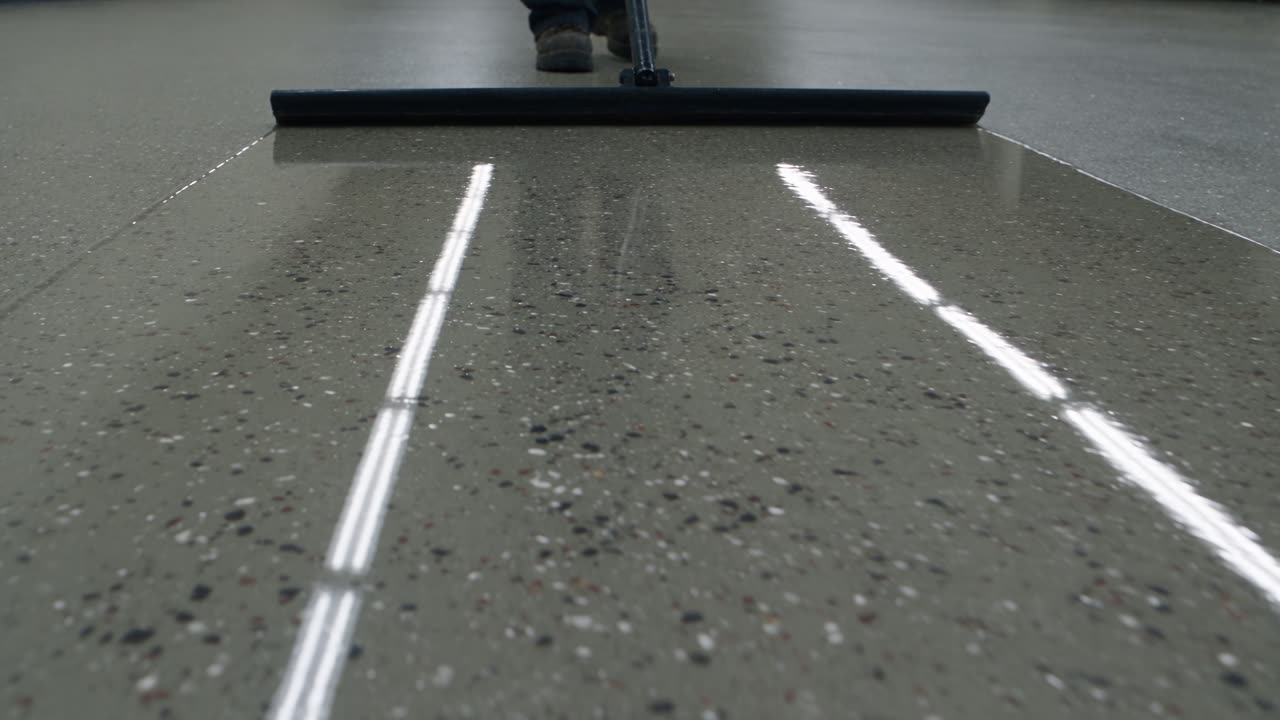
A resin floor in a working building is a wearing surface, and it should be managed like one. The topcoat is sacrificial. It takes the abrasion so that the body of the floor does not, and it is meant to be renewed.
On a busy floor, forklift aisles and doorways wear first. Recoating those zones on a planned cycle costs far less than waiting until the wear reaches the base coats or the concrete. Damage from impact, a dropped pallet or a dragged machine, can be cut out and patched without redoing the room.
Existing resin floors can often be refurbished. If the old coating is sound and well bonded, it is abraded and recoated. If it is lifting, it is removed down to the concrete and the cause, usually moisture or poor preparation, is dealt with before a new system goes down.
How a commercial epoxy project runs
The same five stages, whether it is a forty-seat restaurant or a warehouse.
Site visit
The slab is inspected and tested, the traffic and the cleaning routine are noted, and the constraints on closing are discussed.
Scope and price
You receive a written specification for each area, the schedule and the price. Nothing is booked before this.
Preparation
Stock and equipment are moved or protected. The slab is ground or shot-blasted, repaired and vacuumed.
Installation
Primer, body coats, broadcast and topcoats go down in sequence, area by area, with cove base and line marking where specified.
Handover
You are told when each area can take foot traffic, carts and vehicles, and you get the care instructions for the system.
Questions people ask
How long will my business have to close?
It depends on the size of the floor and the system. Fast-curing systems can be installed overnight and walked on the next morning. Larger floors are usually phased, so part of the building stays in use throughout.
Can you install a floor at night or on a weekend?
Yes. Retail, restaurant and clinic floors are commonly installed outside opening hours, and the schedule is agreed in the written scope.
What is the best floor for a commercial kitchen?
A textured, seamless floor that tolerates hot water, grease and frequent cleaning, usually a quartz broadcast or urethane-cement system with a coved base. Check requirements with your public health inspector.
Can a resin floor take forklift traffic?
Yes, when it is specified for it. High-build epoxy with a hard-wearing topcoat is used in warehouses, with joints filled to support the wheels.
Do you do line marking?
Yes. Aisles, walkways, bays and safety zones are marked in resin as part of the floor, so they wear at the same rate.
What about smell and dust during installation?
Grinding equipment is connected to industrial vacuums to control dust, and low-odour, low-VOC products are used in occupied buildings and near food.
Can you coat over an existing floor coating or old tile adhesive?
Old adhesives and failing coatings are removed. A sound, well-bonded resin floor can often be abraded and recoated. This is decided at the site visit.
How is moisture in the slab handled?
The slab is tested. Where moisture is high, a moisture-mitigating epoxy primer is installed before the floor system.
Is a commercial resin floor slippery?
It is as slippery or as grippy as it is specified to be. Texture is built in with quartz, flake or anti-slip aggregate to suit each area.
More from Epoxy Floors Ottawa
For the full picture, from surface preparation to cure times, and to watch a floor get coated as you scroll, see the main page for epoxy flooring in Ottawa, or go straight to a service.
Tell us about your premises
613-851-7831Call for the quickest answer, or send the form. You will get a call back with the options for your slab and a price.